Short answer
Yes. A modern hair transplant can look natural when it is planned and performed carefully. The key factors are a hairline that suits your face and age, grafts placed at the same angle and direction as your natural hair, single-hair grafts at the very front, and density that fits your donor supply. Afro hair and women's hair need their own techniques. A doctor designs the plan individually.
Key takeaways
- Natural results depend on design and technique more than on the number of grafts alone.
- A soft, slightly irregular hairline looks more natural than a straight, sharp line.
- Single-hair grafts are usually placed at the front edge, with 2–3 hair grafts behind them.
- Each graft should follow the natural angle and direction of the hair around it.
- Afro hair and women's hairlines have specific design and extraction needs.
Why did older hair transplants look unnatural?
Many people picture the 'doll's hair' look of older methods, where hair grew in visible clumps. Those techniques used large plugs of skin with many hairs in each.
Modern methods move individual follicular units, which are the small groups of 1–4 hairs that grow together naturally. Techniques such as Sapphire FUE and DHI allow fine channels and precise placement. The result is that a well-planned transplant today is usually hard to spot, even up close. Hair grows from the scalp in the same small groups it always had, so friends, hairdressers and colleagues usually see hair, not a procedure. Our DHI vs Sapphire FUE guide compares the two.
How is a natural hairline designed?
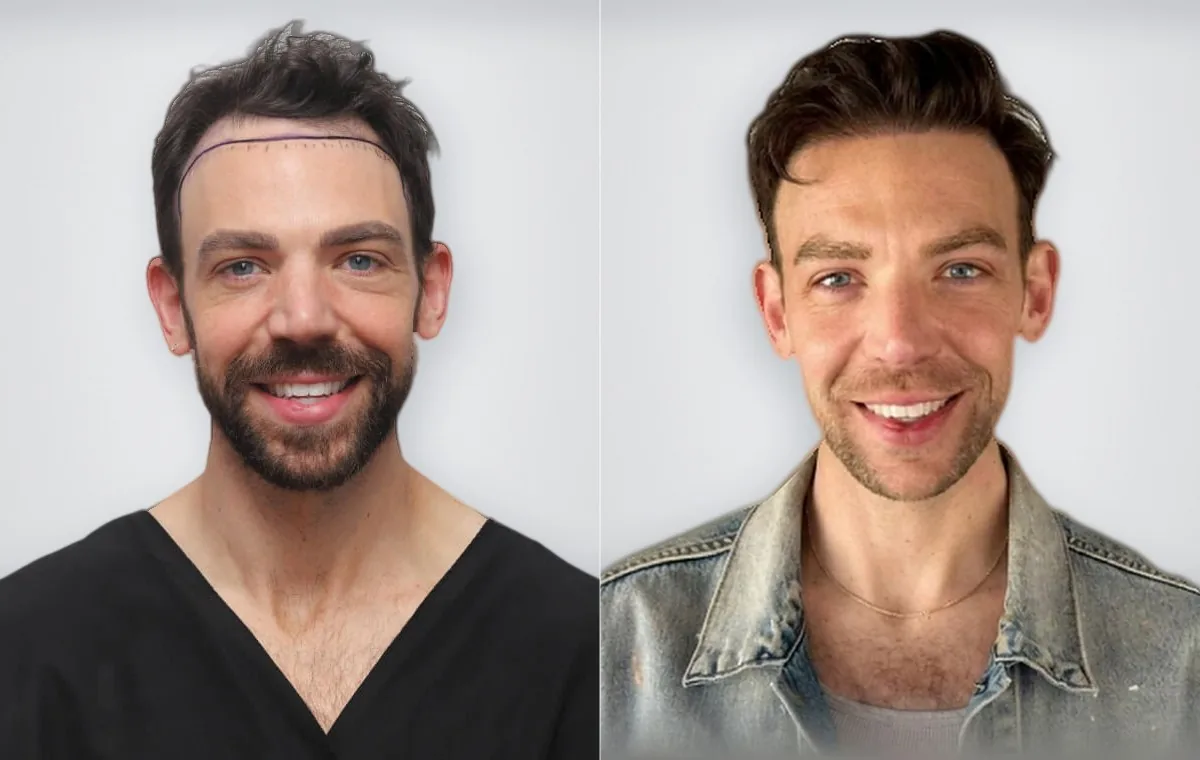
A natural hairline is not a straight line. It has a soft transition zone, small irregularities and gentle curves at the temples. The doctor considers several points when drawing it:
- Face shape and proportions, so the hairline frames the face.
- Age: a hairline that suits you now should still suit you in 20 years.
- The temple points, which strongly affect how natural the frame looks.
- Your donor supply, so the design can be filled with enough density.
- Your own wishes, discussed openly during the consultation.
Why do angle and direction matter?
Natural hair does not grow straight out of the scalp. At the front it usually grows forward and slightly to the side at a low angle. At the crown it grows in a swirl. If grafts are placed too upright or in the wrong direction, the hair sticks out and the result looks artificial even with good density.
Careful channel opening or implanter placement lets the surgeon match each graft to the hair around it. This is one of the main differences between an average and a natural-looking result. The angle also affects how much coverage each graft gives: hair lying at a low angle overlaps the hair in front of it and hides more scalp, while upright hair shows the gaps between grafts. Good angulation therefore improves both the look and the apparent density without needing extra grafts.
Single-hair grafts at the front and density behind
Grafts contain different numbers of hairs. Placing them in the right zone is central to a natural look. A typical layout is shown below; your doctor adapts it to your case.
| Zone | Graft type usually used | Purpose |
|---|---|---|
| Front edge of the hairline | Single-hair grafts | Soft, natural transition from skin to hair |
| Just behind the hairline | Mainly 2-hair grafts | Build density without a harsh line |
| Central frontal area | 2–3 hair grafts | Visual fullness and coverage |
| Crown | Mixed grafts in a swirl pattern | Follow the natural whorl of the hair |
How much density is enough to look natural?
Density is about balance. Too little and the scalp shows through; too much in one area can use up the donor supply needed elsewhere. The aim is enough density to look full in normal light, with priority given to the front, which frames the face.
The number of grafts you need depends on your hair loss pattern, hair thickness and donor area. Our guide on what determines the number of grafts explains this in more detail.
Can Afro hair and women's hair look natural after a transplant?
Yes, with the right technique. Afro hair grows from curved follicles, so extraction needs extra care to avoid damaging them. The curl can give strong coverage, and the hairline is usually designed to follow the patient's natural shape. Read more about our Afro hair transplant, and see the journey of Faubert Joseph, who had 3,490 grafts.
Women often need a lowered or softened hairline, or added density along the parting, while keeping existing hair. In many cases this can be done without shaving the whole head. The women's hair transplant page explains the options.
What mistakes make a transplant look unnatural?
Knowing what to avoid helps you ask the right questions during your consultation. The most common causes of an unnatural result are planning errors rather than technique alone:
- A hairline drawn too low or too straight for the patient's age and face.
- Multi-hair grafts placed at the very front edge, which looks tufted.
- Grafts placed too upright or in the wrong direction.
- Overharvesting the donor area, leaving the back visibly thin.
- Ignoring future hair loss, so native hair recedes behind an isolated transplanted line.
How can you check if a clinic delivers natural results?
Look at real patients with stated follow-up times and clear photos from several angles, ideally 12 months or more after surgery. Our Patient Stories page shows Metropolmed patients treated by our own doctors in our licensed clinic in Istanbul. Ask who designs your hairline and who performs the key steps.
A free online assessment from your photos is a good first step. The doctor can tell you what kind of hairline and density are realistic for you, before you make any decision.
Frequently asked questions
Can people tell I had a hair transplant?
Once healed and grown, a well-planned transplant is usually hard to notice. Natural results depend on hairline design, graft angle and correct use of single-hair grafts at the front.
Will my new hairline look natural as I age?
A good design takes ageing into account, so the hairline is not placed too low. The doctor also considers possible future hair loss when planning.
Do single-hair grafts make the hairline weaker?
No. Single-hair grafts create a soft front edge, while 2–3 hair grafts behind them give density. Together they look natural and full.
Can a hair transplant look natural on Afro hair?
Yes. Afro hair needs careful extraction because of its curved follicles, but it can give good coverage and a natural look when planned well.
Is DHI or Sapphire FUE more natural?
Both can give natural results. The choice depends on your hair, the area to treat and the doctor's assessment.
This article is general information and does not replace a medical consultation. Your doctor will give you a personal recommendation after assessing your case.