Short answer
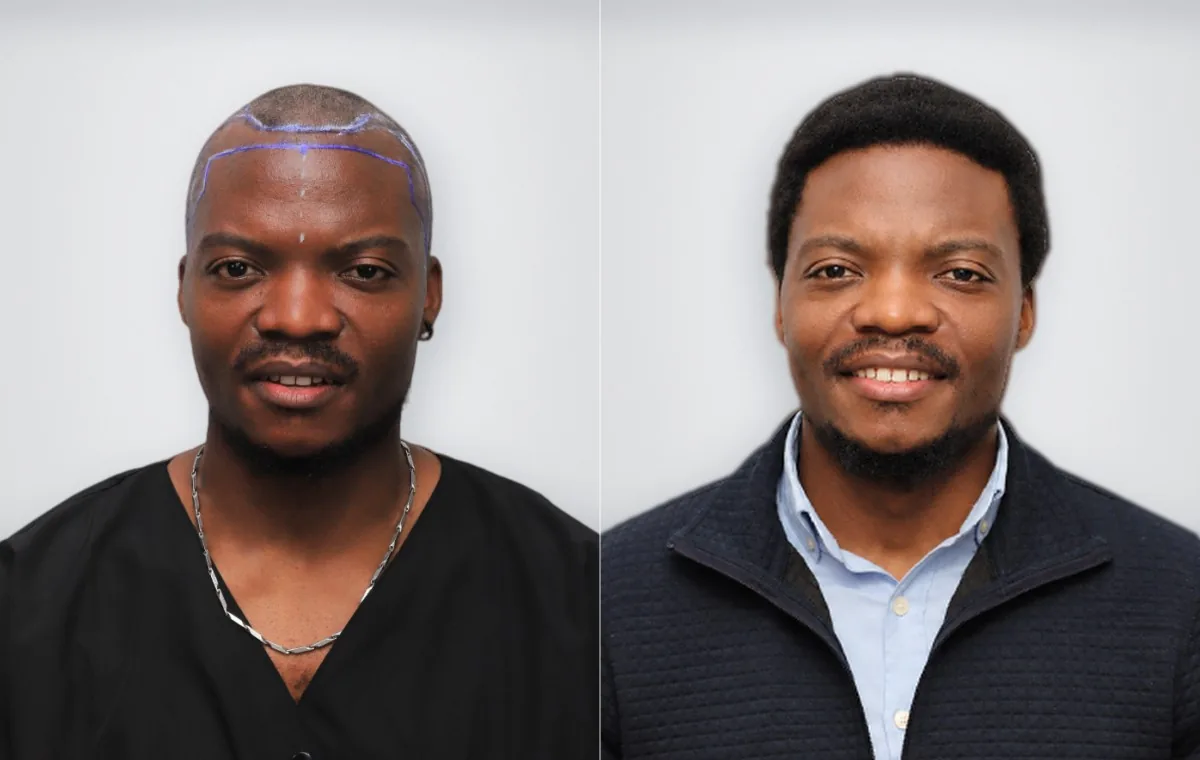
An Afro hair transplant moves permanent, curly follicles from the back of the scalp to thinning areas, using adapted extraction to protect curved roots. It usually takes 6 to 8 hours under local anaesthesia, most patients stay in Istanbul for 3 days, and the final result shows at 12 to 18 months.
What is an Afro hair transplant?
An Afro hair transplant is a hair transplant adapted to Afro-textured hair. The follicles grow in a curve under the skin, so extraction needs an experienced surgeon and adapted instruments to avoid cutting through the root.
In return, each curly graft covers more scalp than a straight one. That means fewer grafts can give strong visual density.
Planning also takes account of your hairline shape, which in Afro-textured hair is often straighter and more defined at the temples. Your doctor designs a hairline that suits your face and your heritage, rather than applying a standard template.
Who is it for?
It suits men and women with Afro-textured hair who have stable hair loss and a healthy donor area.
- Male pattern hair loss at the hairline or crown
- Traction alopecia from braids, weaves or tight styles
- Receding or uneven hairline
- Beard or eyebrow restoration
- Scarring in a limited area
How the procedure is done
Your doctor maps the direction and curl of your hair before extraction. Grafts are removed one by one with adapted punches and checked under magnification, then placed so the new hair follows your natural curl pattern.
Most patients need 3 days in Istanbul. Your hotel, VIP transfers and a medical interpreter are arranged before you land, and a personal coordinator stays in touch from your first message to your 12-month check-up.
The session may be a little slower than for straight hair, because each graft is checked to make sure the curved root is intact. Sedation can be added for comfort on a long day, and needle-free local anaesthesia is used at the start.
Keloid and scarring
Keloid tendency is more common with darker skin, so tell us about any raised scars before you travel. The doctor assesses this at consultation, and a small test area may be recommended before a full session.
Recovery and results
Most people return to work within 3 to 7 days. Avoid tight braids, weaves or wigs on the treated area until your doctor confirms it has healed, usually after about 4 to 6 weeks. New growth starts around month 3, and curl texture develops as the hair matures over 12 to 18 months.
Keep the scalp moisturised with the products your doctor recommends, because Afro-textured hair and skin can become dry during healing. Gentle washing as shown at your first wash helps the crusts come away without pulling on new grafts.
Risks and safety
Temporary swelling, redness and itching are common. Ingrown hairs, folliculitis and keloid scarring are possible, and a lower graft survival can result if curved follicles are damaged, which is why technique matters. A doctor assesses your suitability in person before any procedure.
Recovery timeline
- Day 1-3Mild swelling and tenderness; first professional wash at the clinic before you fly home.
- Day 10-14Small crusts fall away and the donor area looks almost normal.
- Week 2-8Most transplanted hairs shed. This is expected and the follicles stay in place.
- Month 3-4New, fine hair starts to grow through.
- Month 6A clear change in coverage is visible.
- Month 12-18Final result as the new hair thickens and matures.
Frequently asked questions
Is an Afro hair transplant different?
Yes. Afro-textured hair grows from curved follicles under the skin, so extraction needs an experienced surgeon and adapted instruments. In return, each curly graft covers more scalp.
I have a history of keloid scars. Can I still have a transplant?
Tell us before you travel. Keloid tendency is assessed by the doctor at consultation, and a small test area may be recommended before a full session.
Do I need as many grafts as straight hair?
Often fewer for the same coverage, because curl adds volume. Your exact number depends on the area and your donor supply.
When can I wear braids or a wig again?
Usually after about 4 to 6 weeks, once the scalp has healed and your doctor confirms it. Keep tension off the treated area for as long as possible.