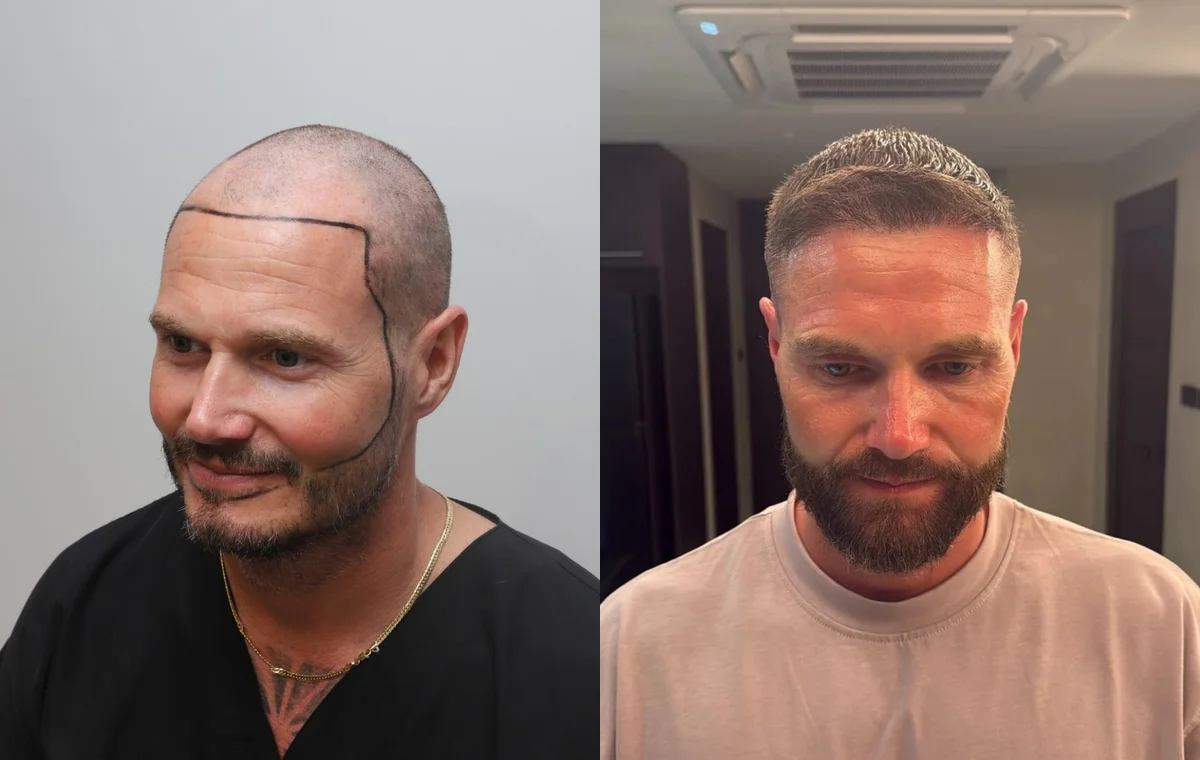
Short answer
A beard transplant moves hair follicles from the back of the scalp to the beard, moustache or sideburns to fill gaps or create a fuller beard. It usually takes 4 to 7 hours under local anaesthesia, most patients stay in Istanbul for 3 days, and the final result shows at around 9 to 12 months.
What is a beard transplant?
A beard transplant is a hair transplant to the face. Follicles are taken from the back of the scalp, where hair is thickest and closest in texture to beard hair, and placed as single-hair grafts in the beard area.
Each graft is set at the precise angle of natural beard growth, which is what makes the result look natural up close.
The result is permanent, because the transplanted follicles keep the growth pattern of scalp hair. This also means the new beard hair may be slightly softer than your existing beard at first, and it blends in as it grows.
Who is it for?
It suits men who want a fuller or more even beard and have a healthy scalp donor area.
- Patchy cheeks or a thin beard
- Gaps in the moustache or goatee
- Uneven sideburns
- Scars from acne, injury or surgery
- Men who want a defined beard line
How the procedure is done
You design the shape and density of your beard with the doctor on the day. The donor area is numbed and grafts are extracted one by one, then single-hair grafts are placed in the beard area with fine instruments or a DHI pen.
Most patients need 3 days in Istanbul. Your hotel, VIP transfers and a medical interpreter are arranged before you land, and a personal coordinator stays in touch from your first message to your 12-month check-up.
Designing a natural beard
A natural beard depends on direction, angle and density more than graft numbers. Beard hair grows at a very flat angle and changes direction across the cheeks, jaw and neck, so each graft is placed to follow that flow.
Your doctor also considers your age, face shape and existing beard. A slightly softer cheek line usually looks more natural than a sharp, dense edge, and the plan keeps enough scalp donor hair for any future needs.
Most patients need 3 days in Istanbul, and your coordinator plans your visit around your schedule.
Recovery and results
Small crusts form around each graft and fall off within 7 to 10 days. Most men return to work within 5 to 7 days. Transplanted beard hair usually sheds in the first weeks, regrows from around month 3, and reaches its final look at 9 to 12 months. It can then be trimmed and shaved like a natural beard.
Follow-up continues after you fly home. You send progress photos to your coordinator at set points over the next 12 months, and the medical team reviews them and answers your questions.
Risks and safety
Redness, mild swelling and small crusts on the face are common for about a week. Ingrown hairs, folliculitis and uneven growth are possible but uncommon. A doctor checks your skin and donor area in person and advises on a realistic density before any procedure.
Recovery timeline
- Day 1-3Mild swelling and redness on the face; first wash at the clinic.
- Day 7-10Crusts fall away and the face looks almost normal.
- Week 2-6Most transplanted hairs shed. This is expected.
- Month 3-4New beard hair starts to grow.
- Month 9-12Final density and shape.
Frequently asked questions
How many grafts do I need for a beard transplant?
As a typical guide: a moustache or goatee needs around 500 to 1,500 grafts, filling patchy cheeks around 1,500 to 2,500, and a full beard around 2,500 to 4,000. Your exact number is set after we see your photos.
Where are beard grafts taken from?
From the back of the scalp, where hair is thickest and closest in texture to beard hair. Single-hair grafts are placed at the right angles for a natural look.
When can I shave after a beard transplant?
You can trim with clippers after about 10 days and shave with a blade after 3 to 4 weeks, once the skin has fully settled.
Can I have a beard and scalp transplant together?
Sometimes, if your donor area is strong enough for both. The doctor decides after assessing your donor supply, because the scalp usually takes priority.